
Did Banning Cousin Marriage Teach the West to Trust Strangers?

November 16, 2026, Patrick Han
The Catholic Church banned cousins from marrying, to break up the tribes, so everyone had to mix with outsiders, trust outsiders and make contracts. That's roughly how the British comedian Jimmy Carr put it on stage, answering an audience question about the Catholic Church. I think the ability to trust strangers doesn't appear on its own. It rests on machinery a society builds over a long time. One explanation says that in the West, the machinery was the medieval Catholic Church's marriage rules, though scholars are still arguing about it. My sources are Harvard anthropologist Joseph Henrich's "The WEIRDest People in the World" (2020), the studies that criticized it, and Emmanuel Todd's work on family structure.
Carr said he isn't religious, but that the Church did a lot of bad things and a lot of good things too. He was talking about how universities and scholarship started in monasteries when he brought this up. He added that the rule cut down on nepotism and corruption, and that as an unintended consequence it made Europe prosper. He didn't give a source. When I looked it up, it turned out to be the central argument of Henrich's 700-page book from 2020.
Most psychology subjects were Western college students
Henrich is an evolutionary anthropologist who studies how culture changes our bodies and minds. In 2010 he published a paper with the psychologists Steven Heine and Ara Norenzayan. Its point was that the "human mind" in psychology textbooks might actually be the mind of a very unusual group of people.
They called that group WEIRD: Western, Educated, Industrialized, Rich, Democratic. The acronym also means what it sounds like. At the time, most participants in studies in the major psychology journals were Westerners, many of them American college students. But when experiments on visual illusions, fairness, cooperation and moral judgment were run again in other societies, WEIRD people often sat at the far end of the human range.
In this lecture, given while he was at the University of British Columbia, Henrich walks through the paper. At that point it was an observation that Westerners are unusual. The book he published ten years later goes one step further and asks why Westerners, of all people, turned out this way.
One trait he points to is how people treat strangers. People in WEIRD societies are relatively quick to trust someone they've just met, try to apply the same rules to relatives and non-relatives alike, and donate blood for strangers at higher rates. Henrich calls this "impersonal prosociality": the tendency to treat even a faceless stranger fairly.
The Church spent a thousand years changing the rules of marriage
Henrich's answer is the marriage rules of the medieval Western Church, which he calls the "Marriage and Family Program." Starting around the fourth century, the Church banned, one by one, marriage to cousins, marriage to a dead spouse's siblings, and taking more than one wife. The ban kept widening, and by around the eleventh century people could not marry even a sixth cousin.
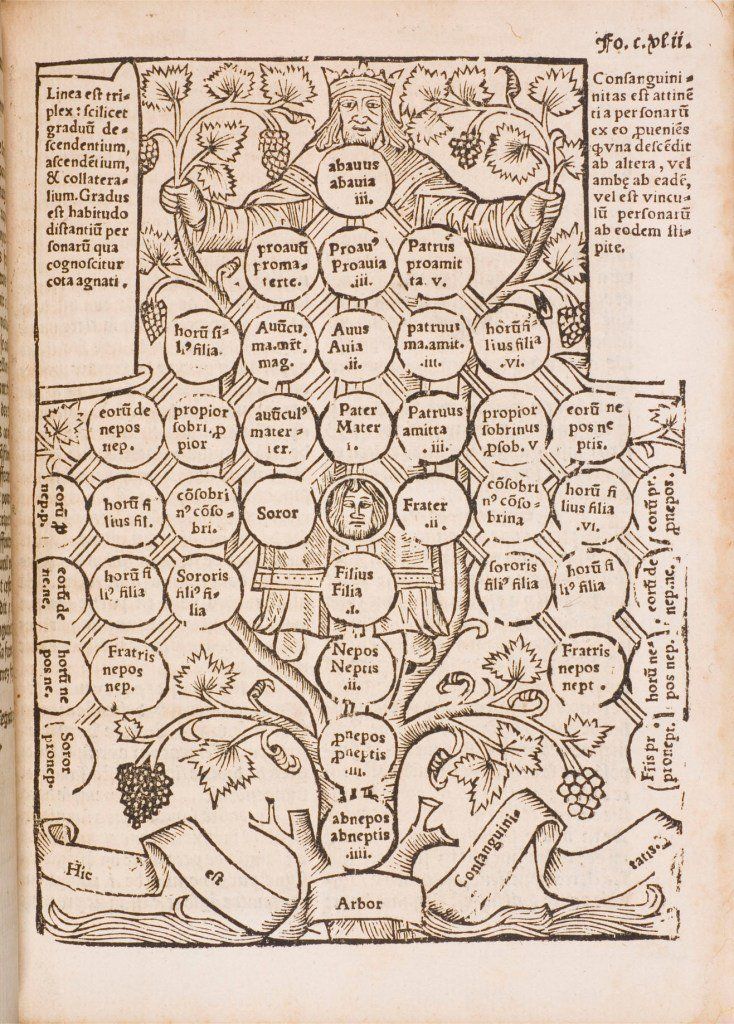
The rule was so broad that it was hard to follow. In 1215 the Fourth Lateran Council cut the ban back from the seventh degree of kinship to the fourth. Carr's "around 1200" and "sixth cousin" mix up two different moments, but the gist matches Henrich's account. According to a review by the economic historian Hilton Root, the ban was proclaimed again at major councils 88 times, all the way into the twentieth century.
As Henrich sees it, the rule shut down the way families had kept property and people circulating inside the clan. If you can't marry your cousin, you have to marry into another family, and within a few generations a large clan scatters. People lived in small nuclear families and moved to cities. And people who shared no blood formed new kinds of groups: guilds, self-governing towns, religious orders, universities.
Students at Bologna, often called Europe's oldest university, organized themselves into "nationes", associations grouped by home region. They were young people who had left home for a city full of strangers and banded together to protect each other. One by one, groups held together by shared rules and promises instead of blood took shape.
Henrich writes that the Church did not foresee any of this. In a 2019 paper in "Science" with colleagues, he tried to show the link with data: the longer a region was under the Western Church's influence, the weaker its kinship ties, the stronger its individualism, and the more fairly people there tend to treat strangers.
The critics have a strong case too
The book drew wide attention, and plenty of pushback. One review said that even after finishing it, why the Church pushed the ban so relentlessly remains a mystery. Root named the book's biggest weakness as its straight-line causality, the attempt to explain everything with a single cause. That way of thinking, he pointed out, is itself WEIRD.
Root also asked about enforcement. The book doesn't say much about how a pope's rule actually made it down to the village church and got followed. Henrich's own notes mention that the Church applied the rules less strictly to noble families. Some reviewers argued that the Church negotiated with an existing reality more than it shaped society.

Other critics point to different evidence. Protestants accepted cousin marriage more readily than Catholics, and in many parts of Europe cousin marriage actually rose in the seventeenth and eighteenth centuries. Critics also said the book lumps non-Western societies together and leaves out the role of the state. Cities and commerce, universities and law all changed during the same centuries, so it's hard to pull out the marriage rules alone and call them the cause. Henrich doesn't claim the Church's rules built everything on their own either. His view is that the rules changed people's psychology first, and institutions like cities and universities could then grow on top of it.
It's also worth being fair about why the Church made the rule. Augustine, the fourth- and fifth-century theologian, held that marrying outside the family spreads love and ties across a wider circle of people. Henrich focused on the Church's interest in acquiring property, while Root gave more weight to a religious zeal for building order amid war and division. Either way, the people who wrote the rules were not picturing a contract society a thousand years later.
Another theory: family structure shapes a country's character
The French demographer Emmanuel Todd is known for predicting the collapse of the Soviet Union early. He argues that family structure is the most important thing for understanding a country's politics and economy. From parents and children we learn how to treat those above us, and from siblings we learn how to treat those beside us.
Todd sorts families by two questions: do grown children live with their parents, and does the eldest son inherit everything or do siblings split it? In his scheme, Korea is a stem-family society where the eldest son inherits, in the same group as Germany, Japan and Israel. In societies like these, being chosen by those above you matters a lot, so labels such as a university name or a big company carry great weight. Calling the youngest employee at a Korean company "maknae", the baby of the family, is a trace of the same thing.
Todd meets Henrich at cousin marriage. Societies that encourage cousin marriage, Todd argues, struggle to build states. Without the historical experience of meeting strangers and forming new families, the idea that people with no shared blood can make up one country feels foreign. Korea is a telling example: fifty million strangers, and the Korean word for country, "gukga", literally means "state-family."
Still, the two pictures point in different directions. In his 2011 book "L'Origine des systèmes familiaux", Todd argued that the nuclear family is actually humanity's oldest form, and that the western edge of Europe is where that old form survived. If he's right, the Church may not have created the nuclear family so much as found that its rules worked well on land that was already close to it. Todd's family data also lean on statistics from the 1960s and 1970s, and his work is controversial.
Read another way, this is the opposite of determinism. A society's tendencies don't decide an individual's fate, and knowing them lets you make your own choices.
Korea banned marriage far beyond cousins
Korea shows that Henrich's theory isn't simple. In the royal house of Goryeo, marriage between cousins was common. But from the Joseon dynasty on, Korea banned marriage between anyone who shared the same surname and clan seat, no matter how distant. The ban went much wider than the medieval Church's sixth cousins.
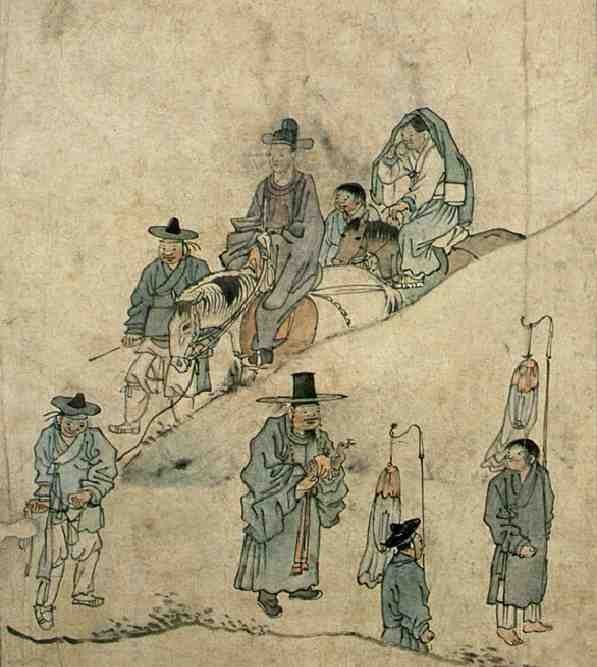
And yet Korea stayed a society of strong lineage associations and family registers, school ties and hometown ties, for a long time. People always married into other families, but the clans didn't scatter. They grew tighter. That reads as a counterexample: a wide marriage ban doesn't automatically weaken kinship networks. In Henrich's framework, Korea's strong patrilineal clans are themselves a structure with intense kinship ties, so explaining this difference takes more than one marriage rule.
The same-surname ban lost force in 1997, when Korea's Constitutional Court ruled it unconstitutional. A 2005 revision of the civil code limited the ban to blood relatives within the eighth degree, effective from 2008. In 2022 the Constitutional Court upheld that eighth-degree rule, five to four. Proposals to narrow the ban to the fourth degree followed, and so did strong opposition. Where a family ends is still an open question there.
America isn't simple either. By Henrich's measure it's the WEIRDest country of all. Yet a founder who had just come back from the US told me over lunch that every cold email he sent in the US was ignored, and doors only opened through an introduction. Even in a society that trusts strangers through contracts and reviews, big decisions still come through people you know. Each country has different machinery for trusting strangers, but no society seems to live without one.
Strangers in the age of AI
We now trust far more strangers than anyone in the Middle Ages did. We send money to sellers we've never met and pick restaurants from reviews by people whose faces we'll never see. Now AI sits in between. We read text AI wrote, trust information AI summarized, and soon someone else's AI agent will buy things and pay for them on our behalf.
So the payment companies are moving first. This September, Visa, Mastercard and Ant International announced they would build a "Know Your Agent" standard together. Just as banks verify a customer's identity (Know Your Customer), it checks whose AI agent is trying to pay and what it's trying to do. Medieval Europe built frameworks for dealing with strangers through guilds and self-governing towns. Now we're building frameworks for dealing with strange AIs.
There's a pull in the other direction too. The Edelman Trust Barometer released at Davos this January surveyed about 34,000 people in 28 countries, and seven in ten said they were hesitant or unwilling to trust someone with different values, background or sources of information. The report called this "insularity." We have more and more strangers to trust, and people are retreating into the circle of people they already know.
Between those two pulls, I feel that places where a stranger becomes someone you can trust are getting rarer. I saw it happen at one of our events. A guest who always slipped away whenever we split a big event into small groups came to a casual mixer once and found a few familiar faces. At the next main event, they stayed for the small group. One evening turned strangers into people they knew.
Last month I told an older friend that the next community would only mean something if people from Korea, Japan, Singapore, the US and China were mixed together in one room. If only Koreans gather, the conversation easily stops at "I hear they're doing this over there." Reading Henrich added one more layer to that thought. The experience of people from different places coming to trust each other under the same rules is hard for anyone else to build for you.
As a Christian, when I read the Church's history I always see the good and the painful side together. This is only where my thinking is right now, but the part about Augustine hoping love would spread beyond the family has stayed with me. Between the intentions of a thousand years ago and the results we see now, there is a lot of chance and a lot of counterargument. Still, the call to treat a stranger as a neighbor seems useful in the age of AI.
Scholars haven't settled whether Henrich is right. Whether the Church's marriage rules were the cause, or only helped a trend that was already underway, remains to be seen. What does seem clear is that the ability to trust strangers didn't arise on its own. It rests on machinery a society built over a long time. I want to watch, slowly, what machinery grows up around AI, the newest stranger of all.
References
- Joseph Henrich, The WEIRDest People in the World (2020)
- J. Henrich, S. Heine and A. Norenzayan, The weirdest people in the world? (2010)
- J. Schulz et al., The Church, intensive kinship, and global psychological variation (2019)
- Hilton Root, review in EH.Net (2020)
- Emmanuel Todd, La Diversité du monde (1999) and L'Origine des systèmes familiaux (2011)
- University of British Columbia lecture, The Weirdest People in the World (2011)
- Constitutional Court of Korea decisions (1997, 2022)
- Payments Journal, Visa and Mastercard Tap Ant International for Agentic Commerce Plans (2026)
- 2026 Edelman Trust Barometer (2026)