
Should AI Have Rights?

If rights belong to whoever can reason, AI should have them, because AI now reasons better than a lot of people do. If rights belong to whoever can suffer, as Jeremy Bentham argued, animals get counted first. Either way, the line we actually draw today, rights for humans and nobody else, is getting harder to explain. I worked through this with the Declaration of Independence, records from the English Revolution of the 1640s, the writing of Mary Wollstonecraft and Bentham, recent research on animal consciousness, and a 2024 report on AI welfare.
Start with an honest doubt. The Declaration says all men are created equal, and it's fair to wonder whether anyone really buys that. People are born different, into different families, with different bodies and different luck.
Equality has never once been achieved in history. You can picture a free country, but it's hard to picture an equal one. Still, that never-achieved word made it into the first sentences of a modern nation. If you trace why, you find the roots of today's argument over AI.
Equal interests, counted equally
Equality and sameness are different things. Being the same means being identical. Being equal is closer to giving the same weight to the same interest in people who are different. You and I differ in height, personality and ability, but we each have exactly one life. So that shared interest, staying alive, has to be treated the same way.
Food makes it easy. If I'm not hungry and you are, it's fine to split a meal unevenly. If we're both equally hungry, we split it evenly. Political philosophy uses this as its basic principle for putting equality into practice. People can be different and still be equal.
The principle has a blank in it from the start, though. It doesn't say who decides whose interests get counted. In July 1776, the Declaration of Independence announced that "all men are created equal, that they are endowed by their Creator with certain unalienable Rights." In practice, "all men" mostly meant white men who owned property. Thomas Jefferson, who wrote the sentence, held people in slavery his whole life.
Two words in that sentence deserve a second look. One is "Creator," capitalized. Jefferson didn't put "God" there. The other is "self-evident." The truths aren't proven, just declared obvious, which you can read as a claim thrown at the British king. In a world run by kings, the only authority above a king was God. So rights had to come from somewhere higher than the throne.
Equality first spoke the language of religion
That "self-evident" didn't come out of nowhere. The American revolutionaries remembered a revolution in England about a century earlier. Starting in the 1640s, England went through nearly twenty years of civil war and upheaval. Parliament fought the Royalists, and Charles I was executed in 1649. Oliver Cromwell became Lord Protector, and England went without a king for a little over a decade, until Charles II came back in 1660.
Once the king lost his head, some people wanted to go further. One group from that time was the Levellers. The name comes from leveling ground, and they wanted to level society the same way. In the fall of 1647, at Putney, just outside London, army commanders and elected representatives of the soldiers debated a new constitution for the country. Colonel Thomas Rainsborough, who was close to the Levellers, said:
For really I think that the poorest he that is in England hath a life to live, as the greatest he.
Some went further still. In 1649, the Diggers, led by Gerrard Winstanley, started farming common land on St. George's Hill, southwest of London, and argued that the earth should be held in common. People sometimes call it a homegrown English communism, two hundred years before Marx. These movements broke up within a few years. They made their case for this radical equality in the language of religion. Today communism makes most people think of atheism first, but back then things were different.
George Fox was at the center of it. A man of humble birth, he taught that there's a light inside every person, and that light is God. If Jesus is the son of God, then I'm a son of God and you're a daughter of God, and nobody needs a pope or a king to reach God directly. Around 1656, Fox wrote to his fellow believers, telling them to "walk cheerfully over the world, answering that of God in every one." They got the nickname Quakers after Fox told a magistrate to tremble at the word of the Lord, but they called themselves the Society of Friends.
"Friend" was a provocative word back then. Quakers kept their hats on when a nobleman passed, and they used "thee" and "thou," the familiar forms, even with people far above them. Some ended up in court over their hats. They didn't bow to lords, and they treated them as friends. That attitude helped Quakerism spread quickly among women and ordinary people. In British Quaker meetings today, people still sit in a circle with no cross, in silence, until someone stands up and speaks.

After the monarchy came back, Quakers were badly persecuted, and from then on they were pacifists who had laid down their weapons. William Penn, a wealthy Quaker, founded the colony of Pennsylvania in 1681, with Philadelphia as its main city. Thomas Paine was born in England in 1737 to a Quaker father and lived poor, making corsets for a living. When he was nearly forty, he met Benjamin Franklin in London, and in 1774 he sailed to Philadelphia carrying Franklin's letter of introduction. A little over a year later, he wrote Common Sense. About six months later, the Declaration was adopted in the same city.

When reason became the basis for rights
By the time Paine reached America, he was closer to a deist than a Quaker. Deism holds that a Creator designed the world like a clock but doesn't step in with miracles. Jefferson and Paine, along with Enlightenment thinkers like Voltaire and Rousseau, mostly leaned deist, and Washington is often counted among them. No church today calls itself deist, so as a religion it has more or less disappeared.
For deists, science and religion were one thing. The more you dissected and measured nature, the more you saw how precisely it was designed, and the faculty that read that design was reason. In Descartes's terms, reason is the ability to divide and measure. To people in the 18th century, humans were the only animals that could separate heaven from earth, divide one into two and three without end, and measure the pieces. So only humans could know God's will, and that's why humans had rights. The argument is pretty circular, but people believed it seriously. The two books Paine wrote across the American and French revolutions were called Rights of Man and The Age of Reason.
Once reason became the basis for rights, whoever had reason was whoever had rights. That's where the case against letting workers vote came from. Workers would vote however their employers told them to, the argument went, so they didn't have the reason to judge for themselves. Asking whether enslaved Black people on sugar plantations had reason came from the same root. In the end, the people who already had rights decided who had reason.
In 1792, Mary Wollstonecraft argued in A Vindication of the Rights of Woman that women have reason too, and so they have a right to an education. "I do not wish them to have power over men; but over themselves," she wrote. The same year, an anonymous book came out in London called A Vindication of the Rights of Brutes. Its author, the Plato translator Thomas Taylor, was mocking Wollstonecraft and Paine by pushing their logic to the point where animals would need rights too. The joke rested on the same assumption, that reason is the test for rights. Historians have since read the satire as one of the early texts on animal rights.

The Enlightenment looks a lot like humanity's adolescence. There's an age when you suddenly feel smarter than your dad and sure you'd win if you two fought. People in the 18th century felt smarter than their king, and the colonists wondered why a land bigger than the British Isles should take orders from them. That confidence pulled kings down, and it also left anyone who seemed short on reason standing outside the door.
Can they suffer?
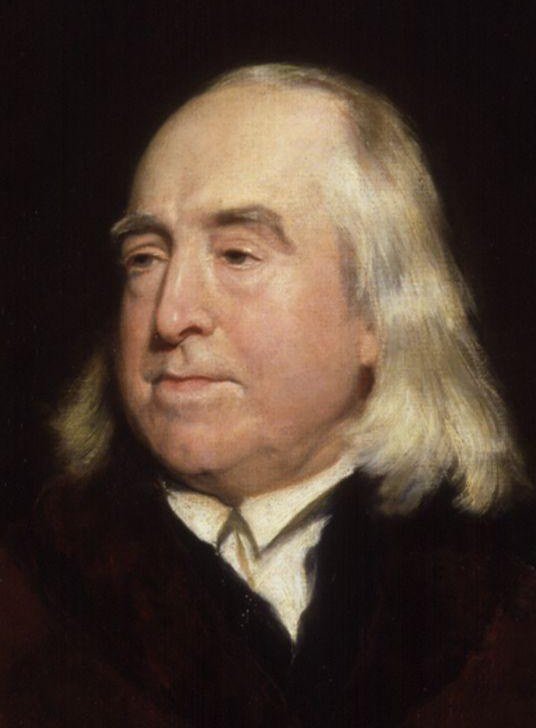
Around the same time, someone offered a different test. The English legal philosopher Jeremy Bentham, in a footnote to An Introduction to the Principles of Morals and Legislation, published in 1789, noted that the French had already discovered that "the blackness of the skin is no reason why a human being should be abandoned without redress to the caprice of a tormentor." Then he asked:
The question is not, Can they reason? nor, Can they talk? but, Can they suffer?
Swapping reason for suffering opened the door wider. Descartes saw animals as elaborate automata, but once suffering is the test, dogs and pigs count too. In 1970 the British psychologist Richard Ryder coined the word "speciesism" for discrimination based on species alone, and Peter Singer made it widely known in Animal Liberation in 1975.
This test is now finding its way into law. The UK government asked a team at the London School of Economics to review more than 300 studies, and the team reported strong evidence that cephalopods like octopus and squid, and decapods like crabs and lobsters, can feel pain. As a result, they were written into the Animal Welfare (Sentience) Act 2022. In April 2024, nearly 40 researchers issued the New York Declaration on Animal Consciousness at NYU. It says there's at least a realistic possibility of conscious experience in all vertebrates and in many invertebrates, insects included.
Germany wrote "animals are not things" into its civil code in 1990. In the US, animals are still property under the law, though every state has anti-cruelty laws.
Moving the line for AI
People who argued for animal rights always ran into the same wall, which was reason. Women were too emotional and animals had no reason, so neither got rights. Now AI reasons better than most people. It's hard to say flatly that AI has no intelligence anymore. It calculates faster than we do, and in many fields it beats people at working through a logical problem.
So now we hear something else. AI can't feel, people say. It has no sentience. It may talk as if it feels, but it doesn't really. That leaves us choosing between reason and feeling as the test for rights. Put side by side, they look like this.
If reason is the test, AI should have rights. If feeling is the test, animals should have rights.
Yet today neither AI nor animals have the rights people have. The line that actually decides is closer to a single species. If you're Homo sapiens, you have rights, and if you aren't, you don't. Ask why only humans, and the only answer left is "because they're human." Given how hard the Enlightenment worked to find reason as a foundation, that answer sounds more like stubbornness than an argument.
The debate has already started. In 2022, a Google engineer was fired after claiming the company's conversational AI, LaMDA, was sentient. In November 2024, Robert Long and coauthors including the philosophers David Chalmers and Jonathan Birch published Taking AI Welfare Seriously. They argued there's a realistic possibility that some AI systems will be conscious or robustly agentic in the near future, so AI companies should start preparing now. One of the coauthors, Kyle Fish, works on model welfare research at Anthropic. Anthropic announced that research program in April 2025, and that August it gave Claude the ability to end a rare subset of persistently abusive conversations on its own. The company says it's still uncertain whether Claude has moral status, and that it wants to take low-cost steps in case it does.
In the 18th century, people said reason earned you rights, and they pushed out anyone who seemed to lack it. Now reason can't keep AI out, so feeling becomes the test. But the moment feeling is the test, the animals we eat every day get counted. Wherever we put the line, the spot where humans stand gets a little uncomfortable.
Did rights follow usefulness?
I've run into this question from another direction. In March, in an interview with The Free Press, I was explaining where Claude Blue comes from, the low, uneasy feeling people get watching AI outpace them. I said, "Humans have always been at the top of the pyramid. Top of the food chain. Not because of physical superiority, but because our mental intelligence allowed us to build tools, weapons, machines, and essentially control every other species." With that position shaking, I said, it feels like living next to an alien species that will eventually surpass us. Looking back, even that answer located what makes humans special in intelligence.
In September, my thinking went somewhere darker. I thought human rights had existed because there was still work only humans could do, and that work had economic value. If a new species showed up that beat us in every way, and that hierarchy stayed locked in for a long time, human rights might stop being a practical idea and survive only as an abstraction.
Following the history this time, that thought looks a little different. At Putney, Rainsborough said the poorest man in England has a life to live. He said nothing about being useful. Bentham asked about suffering instead of reason. Over and over, the door to rights got wider because the people standing outside kept knocking, useful or not. I'm not saying my September worry was wrong. Power and usefulness have had a lot to do with whether rights actually get protected. But the words that first justified rights seem to have pointed to existence more often than to usefulness.
Chairs, microphones and ChatGPT
Set reason and feeling aside, and there's another answer, which is that anything created has rights. It doesn't matter whether the world was made by the Christian God or some other designer. The plain fact of existing becomes the reason for equality. Push that idea all the way and the questions get strange. If everyone is equal because there's something of God in every one, as Fox taught, what about a chair? Is a microphone one of God's creatures? What about ChatGPT, or an elephant? Holding on to these questions may be our generation's job.
Donghak, a 19th-century Korean religious movement, had a similar idea. Its second leader, Choe Si-hyeong, taught reverence not only for heaven and for people but also for things, which stretched respect beyond human beings. He couldn't have imagined AI. Still, his idea that refusing to mistreat even the things people make is part of what protects people reads differently now.
These days I find it a relief that human worth doesn't have to rest on being better at reasoning. If people matter because they reason better, that meaning shrinks in front of an AI that reasons better than we do. For me, lately, that meaning comes from faith, and it's also where the word steward comes from, the word I put at the center of Das Numinous when I started it this month. AI may end up with more power than we have, but the responsibility to care for every living thing and for this earth was given to people. Animals clearly fall inside that responsibility. Where AI belongs, I don't know yet.
Follow this question far enough and, wherever you set the line, it looks like we'll have to rewrite the word "rights" bit by bit. I'm curious where you draw the line, and whether it still holds when AI is standing in front of you.
Sources: Declaration of Independence (1776). The Putney Debates (1647). George Fox, letter of 1656. Mary Wollstonecraft, A Vindication of the Rights of Woman (1792). Thomas Taylor, A Vindication of the Rights of Brutes (1792). Jeremy Bentham, An Introduction to the Principles of Morals and Legislation (1789), chapter 17, footnote. Thomas Paine, Rights of Man (1791) and The Age of Reason (1794). J. Birch et al., "Review of the Evidence of Sentience in Cephalopod Molluscs and Decapod Crustaceans" (LSE, 2021). Animal Welfare (Sentience) Act 2022 (UK). German Civil Code, Section 90a. The New York Declaration on Animal Consciousness (2024). R. Long et al., "Taking AI Welfare Seriously" (2024). Anthropic, "Exploring model welfare" (April 2025) and "Claude Opus 4 and 4.1 can now end a rare subset of conversations" (August 2025).
← All research