
Why Anthropic Cut Up Millions of Paper Books

November 17, 2026, Patrick Han
AI companies are going to keep wanting paper books, and I think the price of those books will shift toward something agreed with authors in advance. My evidence is a NewsPicks reporter's October 2026 broadcast on the Nippan and Anthropic affair that shook Japanese publishing this fall, the ruling and the $1.5 billion settlement in the Anthropic lawsuit, and the long history of books and copyright that runs from the Library of Alexandria to the Statute of Anne.
What happened in Project Panama
In February 2024, Anthropic hired Tom Turvey, who had led partnerships for Google Books at Google. According to the court's ruling, his job was to get "all the books in the world," while avoiding legal and business hassle as much as possible.
That spring Turvey sent an email or two to a few major publishers asking about licensing books for AI training. The ruling notes that if those conversations had continued, a deal might have been possible. They fizzled out. His team instead contacted book distributors and retailers and bought physical books in bulk, mostly used ones.
There was plenty of back and forth about where to get them. A March 2024 meeting document reported by "The Washington Post" includes a note that the Strand, New York's famous used bookstore, might be willing to supply used books. Employees also talked about reaching out to the New York Public Library or to libraries that are "always short on money." The Strand says it never sold books to Anthropic. The books actually came mostly from big used book distributors such as Better World Books in the US and World of Books in the UK, tens of thousands at a time.
After that, the process ran like a factory. A vendor tore off the bindings, trimmed the pages to size and scanned them. Each book became one PDF, and the paper was thrown away. The ruling says Anthropic spent many millions of dollars to buy millions of books. "The Washington Post" reported that the spending reached tens of millions of dollars over a little more than a year.

The project's name became public in January 2026. "The Washington Post" reported on internal planning documents drawn from more than four thousand pages released during the lawsuit. One line read, "Project Panama is our effort to destructively scan all the books in the world." Another said, "We don't want it to be known that we are working on this."
The NewsPicks reporter explained what "destructively" means. A place like Japan's National Diet Library scans books without cutting them, opening them one page at a time. The ethical question comes from cutting up and discarding even out-of-print books and used books that had been passed around for years. He also pointed to the project's goal: rather than learning from low-quality text on the internet, the model would learn how to write well from books from the era before the internet.
The ruling tells the same story. As Anthropic trained one model after another, it became convinced that books were the most efficient material for building a world-class language model. Sentences that people had edited and polished turned out to be the best textbook for AI too.
The court compared AI to a reader
The case began in August 2024, when the author Andrea Bartz and other American writers filed a class action claiming Anthropic had used their books for training without permission. It became "Bartz v. Anthropic". On June 23, 2025, Judge William Alsup of the federal district court in San Francisco issued his first ruling.
The ruling split in two. Training AI on books that were lawfully purchased was fair use, the principle in American copyright law that allows a work to be used without the owner's permission in some cases. Judge Alsup wrote that, like any reader who hopes to become a writer, Anthropic's models trained on works "not to race ahead and replicate or supplant them" but "to turn a hard corner and create something different."
He didn't object to cutting up and scanning the paper books either. His reasoning was simple. The paper original was gone, and a single digital copy took its place. The number of copies didn't grow and nothing left the company, so he saw it as a change of format to save storage space. Throwing the books away actually helped Anthropic's case.
The other half went differently. Before it bought paper books, Anthropic had downloaded and kept more than seven million books from pirate sites. The judge said that part couldn't be fair use. The point that you can't take any textbook you like just because you say it's for research had in fact been made in court by Anthropic's own lawyer.
In the end Anthropic settled for $1.5 billion without admitting wrongdoing. It works out to a little over $3,000 for each of about half a million books found in the pirated collections, the largest settlement in the history of US copyright litigation. The court gave final approval in July 2026, and some authors have appealed.
How Japan's books were sold
The Japanese story started in the records of this lawsuit. A list of book suppliers in the released documents included the name "Nippan Japan." The amounts and the number of books were blacked out. Judging by the width of the redacted boxes, the NewsPicks reporter guessed it was hundreds of thousands of books, worth several hundred million yen. Next to the date September 18, 2024, the words "negotiated discount rate" were visible.
On September 17, 2026, the Japan Book Publishers Association sent a letter of inquiry to Nippan, one of Japan's largest book wholesalers. The first page, which the reporter obtained, said in effect that publications their members had poured care into and sent out into the world had been treated as nothing more than training data, their spines cut off and the books thrown away. The association asked two things: whether the sale really happened, and how it squared with Japan's resale price maintenance system.
Under that system, books in Japan have to be sold at the price the publisher sets. A seller can offer a discount on a large bulk sale, but only with the publisher's consent. Part of the industry's anger was that this step had been skipped.
Nippan replied on October 5. It admitted that its subsidiary Nippan IPS signed a contract with Anthropic in November 2024 and sold it books from December 2024 through December 2025, including books from association members. But it said it didn't know they were for AI training, that the contract didn't state how they would be used, and that the consent requirement didn't apply because this was an overseas sale. It didn't say how many books it sold or for how much.
The reporter thought this answer made publishers angrier. The other side was Anthropic, so what purpose besides AI could there have been? Many in the industry saw it as a subsidiary that sold the books by mistake without realizing how big it would get. The reporter himself suspected the opposite: that Nippan didn't ask because it knew the publishers would say no.
He also said the conflict didn't come out of nowhere. Grievances had been building for years between the wholesalers and the publishers who had held up Japanese publishing together, and this case brought them all to the surface at once. The press split too. Some outlets ran it big as an "unauthorized sale," while others argued that a bookseller has no duty to get permission for who it sells to. The reporter felt both sides were leading with emotion.
Alexandria kept the originals
The dream of collecting every book in the world isn't new. In the third century BC, the Ptolemaic dynasty in Alexandria, Egypt, set out to collect every book in the Mediterranean world. The result was the Library of Alexandria, the largest library of the ancient world.

Its methods were fairly rough. According to the second-century Roman physician Galen, whenever books turned up on a ship entering the port of Alexandria, they were all taken to the library. Scribes made copies and gave the copies to the ship's owner, and the library kept the originals. These books were reportedly labeled "from the ships."
Galen tells a more famous story too. Ptolemy III asked Athens to lend him the official manuscripts of the tragedies of Aeschylus, Sophocles and Euripides. Athens demanded a huge deposit of fifteen talents of silver. The king paid it, took the manuscripts and had them carefully copied on fine papyrus. Then he sent the copies back to Athens and kept the originals, simply giving up the deposit.
These stories were written down centuries later, so they're hard to take at face value. Still, they show what ancient people valued. Alexandria gave up a fortune to own the originals, and handed out copies without a second thought.
Project Panama did the reverse. It cut up and threw away the originals and kept only the copies. What the AI needed was just the sentences inside. And an American court said that because the originals were gone, the whole thing could be treated as a simple change of format. Over two thousand years, the weight of a book seems to have moved entirely from the paper to the words.
Google Books sits somewhere in between. In 2004 Google began scanning books in partnership with university libraries including Michigan, Harvard and Stanford. Google borrowed books from the libraries, made copies and returned the originals to the shelves. It used the copies to let people search the text of books, to make books available to blind readers and to guard against losing the originals. The Authors Guild sued in 2005, but in 2015 an appeals court ruled that this too was fair use. Tom Turvey, whom Anthropic hired twenty years later, was the person who ran partnerships for that project. The same man gathered the world's books twice, once by sending them back to the shelves and once by cutting them up.
When the Library of Alexandria disappeared, people remembered it as a tragedy for humanity. Today, even when a book is cut up, the words inside survive somewhere. But who holds those words and what they're used for is often something the author doesn't know. That's close to what made Japanese publishers so angry.
Copyright was made for learning
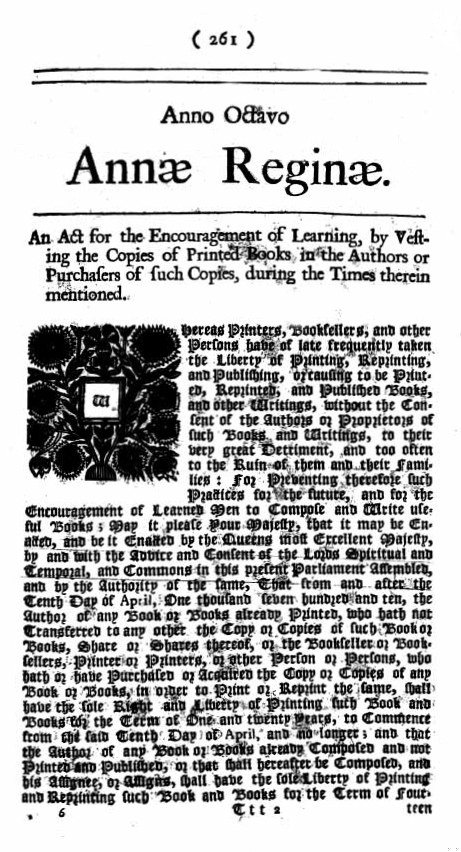
The Statute of Anne, often called the first modern copyright law, took effect in Britain in 1710. Its official title was "An Act for the Encouragement of Learning." Before it, the right to print books was held by the guild of London booksellers. This law gave authors, for the first time, the right to print their own books for fourteen years.
The US Constitution carried the same idea forward. It says Congress can set copyright in order "to promote the Progress of Science and useful Arts," and Judge Alsup quoted that phrase in his ruling. Copyright was a way to let writers earn money, and in the end it was also a way to get more people learning more.
AI reading books and learning from them fits that old purpose in an odd way, which is why the court compared AI to a reader who wants to be a writer. When a person buys a book, they don't pay the author again no matter how many times they read it or what they learn from it.
Society has already put a separate price on reading, though. Denmark in 1946 and Britain in 1979 created public lending right systems, which pay authors a small amount each time their book is borrowed from a library. The idea is that when many people pass one copy around, the author loses sales they would otherwise have made. AI turns one book into knowledge that hundreds of millions of people use together, and the same question can be asked of a reader like that.
Countries answer it differently. The US left the door open through fair use and charged heavily only for the parts that crossed the line, such as piracy. Japan's copyright law, in Article 30-4 which took effect in 2019, generally allows uses that aren't meant for enjoying a work, such as data analysis. On AI training alone, it's one of the most permissive countries in the world. That's why Japan's anger this time was aimed less at training itself and more at selling and cutting up books without consent. Since 2019 the European Union has required that works be left out of training if the rights holder opts out in a machine-readable way.
Asking the people who wrote the books
While reporting the story, the NewsPicks reporter found that his own book was on the list of books that had been sold. The host asked how he felt about it as an author. His answer was calm. He said he could see how it happened, and that when the law hasn't caught up, things like this are bound to happen. But he said he would have liked to decide for himself whether his book could be used for training, and to be paid accordingly.
He also spoke for the publishers. A serious publisher, he said, would have seen AI companies as a big new customer and negotiated, organizing the data and putting a price on it. That chance was taken away, so he could understand wishing someone had at least asked first. He put four questions to Nippan directly by phone and email: whether his book was included, what Nippan thought the books were for if not AI, how much they were sold for, and whether Nippan had sold to anyone besides Anthropic.
Deals that do ask are starting to appear. In November 2024 the American publisher HarperCollins signed an agreement letting an AI company train on nonfiction titles for three years. It paid $5,000 per book, split evenly between author and publisher, and only books whose authors agreed were included. It's exactly the kind of deal Judge Alsup wrote might have been possible if Turvey had kept talking to publishers.
This approach has limits too. The Authors Guild criticized the even split as giving publishers too much. Nobody knows yet whether a few thousand dollars a book is a fair price, and it's an open question whether negotiating millions of books one at a time is realistic.
This affair made it clear that AI learns best from human books. Anthropic paid a lot of money and took on real legal risk to get paper books because nothing teaches as well as sentences people have spent a long time refining. If that's true, then how the people who wrote those sentences take part in AI's learning is something we need to work out as well.
The king of Alexandria gave up his deposit to own the originals. Today's AI companies are paying in lawsuits and settlements to throw the originals away and keep the copies. Whether the next step will be asking authors first and setting a price together, nobody can say yet. What Japan's publishers and Nippan decide will likely be one piece of the answer.
References
- NewsPicks, report on Nippan's bulk book sale to Anthropic (2026)
- Bartz v. Anthropic, order on fair use (2025)
- The Washington Post, reporting on Project Panama (2026)
- Authors Alliance, Bartz v. Anthropic settlement receives final approval (2026)
- AdverTimes, Nippan admits selling Japanese books to a US AI company (2026)
- Galen, commentary on Hippocrates' Epidemics, Book 3
- Statute of Anne (1710)
- Japan Copyright Act, Article 30-4
- Authors Guild, on the HarperCollins AI licensing deal (2024)