
Is the AI Revolution, Like the Printing Press, Only Beginning?

I think AI will look less like a single revolution and more like the printing press, a change that shakes the world again and again over decades, as long as 150 years. If so, today's LLMs are roughly where printing was in the 1510s, decades after the first press, when pamphlets were starting to spread, and the bigger changes may still be ahead. Much of it draws on the historian Ada Palmer, who teaches the Renaissance at the University of Chicago and wrote the four-book science fiction series Terra Ignota. To that I added historical records such as the Gutenberg Bible and the court papers from his lawsuit, along with essays that compare AI to the printing press and essays that push back on the comparison.

Why did Gutenberg go broke?
Palmer tells the story of Gutenberg going bankrupt, and she exaggerates it on purpose. He figured out how to print 300 copies of a book for the price of one. So he printed 300 Bibles. Then it turned out only seven people in his town could buy one.
Congratulations, Mr. Gutenberg, you have 293 Bibles, and you can't sell them, and you go bankrupt.
The real numbers are a bit different. About 180 copies of the Gutenberg Bible were printed, and 49 survive today. In 1450 and again in 1452, Gutenberg borrowed 800 guilders from an investor named Johann Fust. In a lawsuit dated November 6, 1455, Fust won, and the shop where the Bibles were printed passed to him. Debt and a lawsuit brought Gutenberg down more than unsold Bibles did.
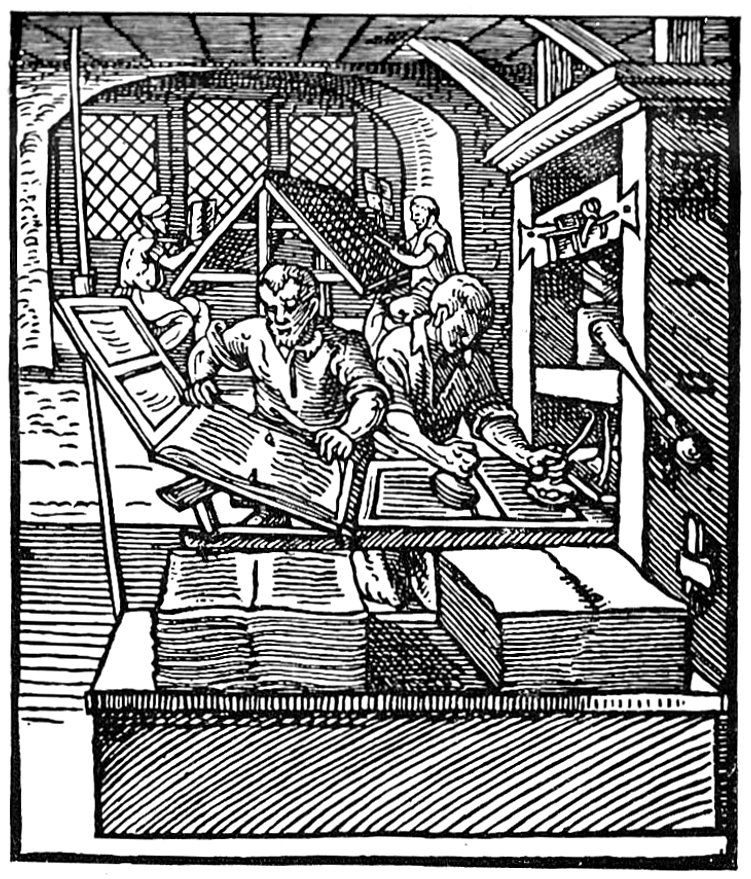
Palmer's point still holds, whatever the numbers. Being able to make a lot of something and having a market to sell it to are two separate things. There were more than 300 people in Europe who wanted a Bible. There weren't 300 of them in one town.
Her example is the e-book. E-books existed the first time anyone typed a book into a computer. There were e-books in the 1970s. But there was no market for them until the Kindle came along and made them easy to buy and sell. It took decades to get from the technology existing to the technology changing anything.
Printing went the same way for its first few decades. In 1472, two printers in Rome were stuck with nearly 10,000 unsold books and asked the pope for help. Printing started to pay only after it reached Venice. Venice was a trading port full of ships, and roughly one in eight books printed before 1500 came from there. Aldus Manutius opened a press in Venice in 1494. In 1501 he printed Virgil in a small format you could carry in one hand, set in italic type, and that book is often called the ancestor of today's paperback.
Printing changed the world many times over 150 years
Palmer brought all this up to explain our own time. We've lived through the computer, the personal computer, the internet, the cell phone, social media, and now LLMs. It's easy to feel each of these as its own revolution. She sees them as one technology, the computer, sinking deeper and deeper into everything.
It's one information revolution having multiple successive revolutionary applications as it disseminates and eventually saturates.
The timeline of printing shows what she means. The press arrived around 1450, but printers didn't start making money until the 1490s. In the 1510s came the age of pamphlets, and news started traveling in print. Palmer says that shift was as big as the jump from computers to cell phones.
When Luther posted his Ninety-five Theses in 1517, they reportedly spread across Germany in two weeks and across Europe in two months. In the three years starting in 1518, around 300,000 copies of Luther's writings were printed. Palmer says the Reformation was made possible by pamphlets in exactly the way the Arab Spring was made possible by cell phones.
The next wave was the newspaper. A paper that comes out every week loses subscribers if it prints nonsense. So it had to build a reputation, and that reputation became trust.
The newspaper is a way of fact-checking the pamphlet.
According to Palmer, printing kept shaking Europe like this for 150 years, with a new shock every decade or two. In an interview this March, she said today's digital revolution will also unfold in stages over decades, maybe as long as 150 years.
Back in 2023, in an anthology of essays on AI put together by Microsoft, she described ChatGPT as both the newest butterfly and a chrysalis holding the next one. In other words, ChatGPT is a big change in its own right and also the stage where the next change is growing. LLMs probably won't be the last change.
The press came when people needed more books
The writer Dwarkesh Patel brought up oil with her. Oil was first drilled in 1859, but cars, which made people use oil in huge amounts, weren't mass-produced until decades later. Palmer stressed the other direction. When people need something, an invention shows up to meet that need.
Starting in the 1410s, Europe went through a boom in library building. To make books cheaper, people made them smaller and used more paper instead of parchment. Paper use was already climbing fast before Gutenberg's press appeared.
So Gutenberg isn't a random genius out of nowhere. It was the moment that people needed more books. We were going to get the invention.
Apply that to AI and the better question becomes why we need this now, more than who built it first. And as Gutenberg's story shows, the person who builds it first isn't the one who makes the most money. The money went to trading ports, book fairs, and the many small shops printing pamphlets.
Petrarch's plan failed, and the world got better anyway
The most talked-about part of Palmer's argument is somewhere else. Patel said a lot of people have their own idea of how to make AI go well, yet historically nobody has a good track record of steering a huge change toward their own values. Palmer answered this way.
I think "go my way" as opposed to "go well" is a really important distinction.
Her example is Petrarch. Petrarch survived the Black Death in the 14th century and lost most of his friends. Two friends who had made it were on their way to visit him when bandits attacked them, and one was killed. He called his own time "an age of ash and shadow." He thought leaders cared more about their wealth and family honor than about their people, and he believed that if the next generation of rulers were raised on the books of ancient Rome, the world would get better.

The plan didn't go the way he hoped. The first generation raised on the classics produced Cesare Borgia, and the wars got even more brutal. Classical learning then flowed on to Machiavelli and Galileo, in directions Petrarch never imagined. Palmer says that if Petrarch saw our world, he'd be horrified by democracy, since he believed only a tiny elite was fit to rule. But if he learned we can treat the Black Death, he would weep for joy.
He did not create a world that went as he wanted, but he created a world that went well.
Trains and bicycles come up as another example. Once travel got easier, women could move around on their own, meet, and organize, and the suffrage movement gained strength. The inventor of the train never intended women's liberation or pictured that future, she said, and it turned out well anyway.
That distinction is useful for the AI debate. Companies, governments and researchers each have their own picture of what AI should look like. If Palmer is right, none of those pictures is likely to come true as drawn. That doesn't mean we should stop trying. It's closer to saying the goal should be for things to turn out well for people, more than for things to match the picture you drew.
What people at the time missed
When news reached Europe that Columbus had landed in the New World, people weren't especially impressed. Someone had found something across the sea to the west, maybe as big as the Canary Islands. And at the same time France was invading Italy and the Ottoman Empire was a threat, so the wars right in front of them felt far more urgent.
No matter how big and important something far away is, it's hard to bring your mind out of the petty squabbles that are happening right around you, especially when they feel like life or death.
Censors got it wrong too. In 18th-century Paris, the men raiding clandestine bookshops waved off Voltaire and the Encyclopédie and went after Jansenist pamphlets. Looking back, it was Voltaire's side that changed history.
Patel pointed out that people in 1506 were nostalgic for 1490, and in 2026 we're nostalgic for 2000, and asked whether the world sped up back then. Palmer said history has always moved fast. Schools cover long stretches of time quickly, so they teach it as if it moved slowly. Zoom in on any decade, anywhere, and it feels as hectic as today.
Technologically, they were moving fast. We just don't care about those technologies anymore.
She means things like chairs with backs, scissors, and better steel. To people at the time, each of these was a new invention.
Her March 2025 book, Inventing the Renaissance, takes its title from here. It takes apart the idea that the Renaissance was a golden age, and this year it won the Hugo Award for Best Related Work, a science fiction prize, which is rare for a history book. In her view, the split between dark ages and golden ages is a story told later. Petrarch is usually credited as the first to see antiquity as light and his own time as darkness. He never actually used the phrase "Dark Ages," though, which only shows up in the early 1600s. It was 19th-century writers who called the Renaissance a golden age. Petrarch, who lived through it, called his own time an age of ash and shadow.
Printing, censorship and social media
Printing also changed the history of censorship. Thick books could be policed. Pamphlets couldn't. Printers were the ones who paid the people carrying the news, so they heard first when an inquisitor was coming. The printer packed up and moved to the next town, and someone else took over the shop.
You cannot censor whatever moves the information fastest because it will move the information faster than you can move.
Palmer says social media is in the same position. Ask a platform to filter out hate speech or pornography and it says it can't, because there's too much and it moves too fast. Censors in the 16th century had the same problem.
Speaking with FIRE, a US free speech group, she said this year that every information revolution is also a censorship revolution. Every time the technology for moving information changes, the methods of censorship change with it. She said the thing to worry about now is automation more than AI itself. Computer-automated censorship is a much bigger problem than AI, she said, and it was here before AI arrived.
Is AI really like the printing press?
Palmer isn't the only one comparing AI to the printing press. Emily Chamlee-Wright of the Institute for Humane Studies wrote in Persuasion last May that the printing press ended up getting more people to read and write. Lawyers at the firm Debevoise & Plimpton wrote on their blog last month that good automation keeps expertise valuable and moves it to where it's needed most.
There are voices on the other side, of course. In January, Christopher Roosen wrote a piece called "AI Is Not A Printing Press." The press was a copying device, he wrote, and it didn't create content. AI puts endless amounts of content in everyone's hands without ever getting tired. The press spread what people wrote, while AI does the writing itself, so it's worth asking how far the comparison really goes.
Danny Steiner lands in between. If the printing press changed the cost of spreading ideas, the economics of thought, he wrote, AI may change who, or what, can create knowledge and act on it.
Palmer herself doesn't push the comparison all the way. What she takes from printing is less a prediction and more a few patterns that keep repeating. A technology takes time to start paying. The later uses change the world more than the first ones. And the people living in the middle of it can't tell what matters.
Where are we now?
Line Palmer's timeline up with today and LLMs might be the pamphlets of the 1510s. The underlying technology came decades ago, and it's only now seeping into everyday life and causing shocks big and small. If so, something like the newspaper should come along too, some way to sort out what's trustworthy from everything AI pours out.
The noise we feel most right now may look as small in 100 years as the news about Columbus did. On the other hand, something nobody is paying attention to today may end up defining this era, and the people living through it will have a hard time seeing it.
Palmer also tells a story about the Inquisition after Galileo. To check the experiments in the science books sent to them for censorship, Vatican censors repeated the experiments themselves, and in doing so they more or less invented peer review. Some of them worked as inquisitors by day and went home at night to write their own scientific treatises. Then she sums it up.
It's not what we expect, but history is never what we expect.
Palmer's quotes were checked against the original transcripts. For numbers like how many Gutenberg Bibles were printed, I went with the historical record instead of the round numbers Palmer used to make her point.
Sources: Dwarkesh Podcast, "Ada Palmer: Why Leonardo was a saboteur, Gutenberg went broke, and Florence was weird" (Mar 2026). Ada Palmer, Inventing the Renaissance (University of Chicago Press, 2025). Lit Hub on the 2026 Hugo Award winners. Sam Matey, "Interview with Professor Ada Palmer" (Mar 23, 2026). FIRE, "So to Speak: Ada Palmer on the history of censorship from the Renaissance to AI" (2026). Ada Palmer, "We are an information revolution species," Microsoft AI Anthology (2023). Ada Palmer, "How is Inventing the Renaissance an SFF-Related Work?" on ExUrbe (Jan 29, 2026). Emily Chamlee-Wright, "Our Gutenberg Moment," Persuasion (May 30, 2025). Christopher Roosen, "AI Is Not A Printing Press" (Jan 18, 2026). Danny Steiner, "What Past Tech Revolutions Teach Us About AI" (May 12, 2026). Debevoise & Plimpton Data Blog, "The Future of Legal AI: Lessons from Gutenberg's Printing Press" (Oct 12, 2026). Wikipedia, "Gutenberg Bible," "Incunable," "Aldus Manutius," "Dark Ages (historiography)."
Photos: Sanna Pudas (CC BY 4.0).
← All research