Adobe on Commercial Licensing as the Moat in the AI Era

On Wednesday, November 11, I moderated the Global AI Forum at Grand Hyatt, held in cooperation with Korea's Ministry of SMEs and Startups. I was on stage all day. From 11 am to 5 pm, Mistral AI, Liquid AI, Mercari and Adobe each gave a talk and then sat down with me for a conversation. Adobe closed the day with the 4 pm session. I know Adobe through Premiere Pro, Photoshop and Illustrator, but this session came from the enterprise business behind those tools.

Building AI features like LEGO blocks
Allan Ambe is an Agentic Commerce Consultant for Adobe Commerce, and he runs AI Tinkerers Seoul. His talk was about how to build AI features your competitors can't copy.
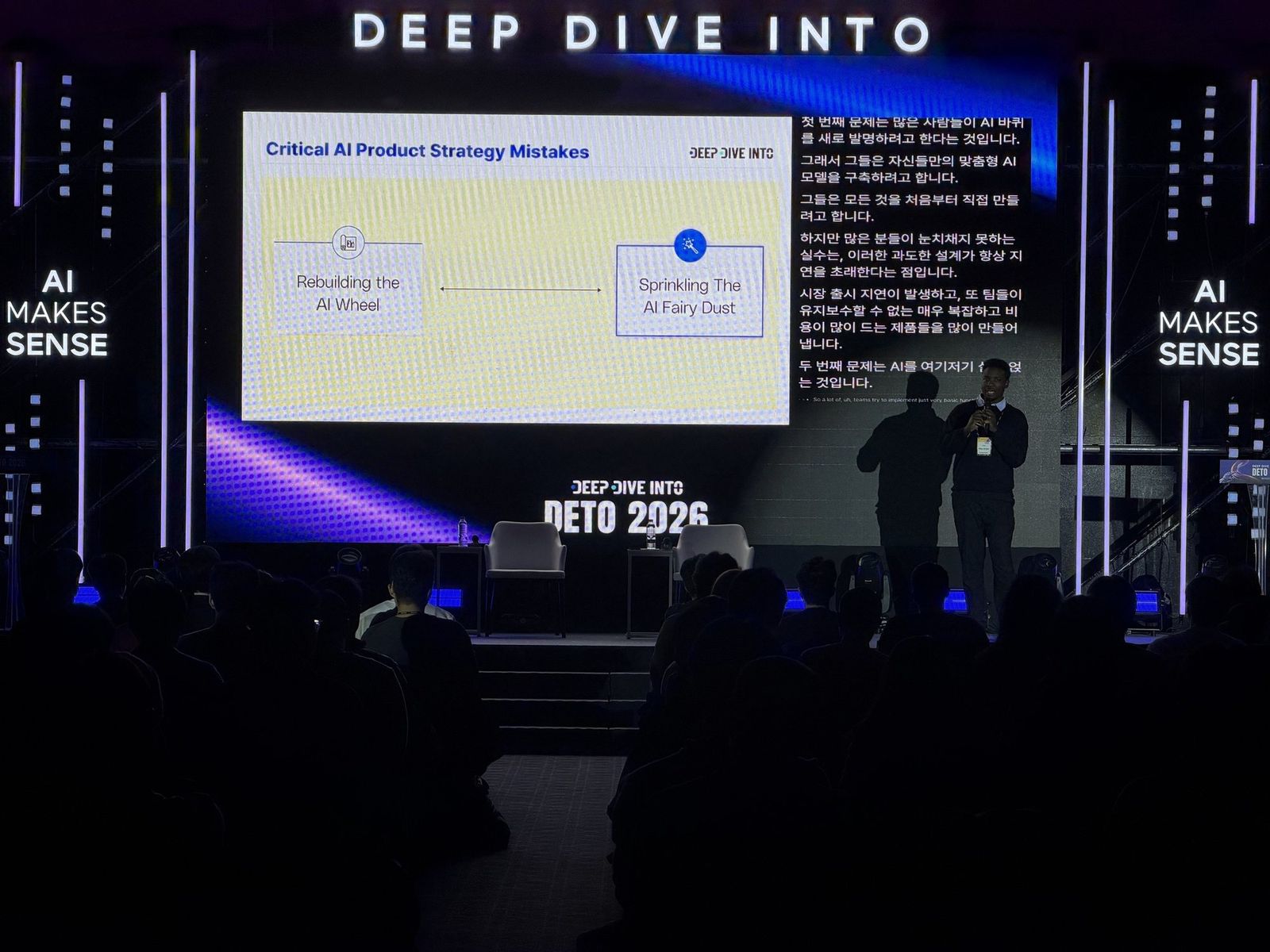
Allan started with the mistakes teams commonly make when they build AI products. The first is reinventing the AI wheel. A team builds its own model from scratch, the launch slips, and the result is a product too complex and too expensive for the team to maintain. Another common mistake is sprinkling AI fairy dust. A company bolts on a basic chatbot and calls it an AI feature, and competitors copy that kind of chatbot quickly. Relying only on API access to flagship models from companies like OpenAI or Anthropic has its own risk, since the whole product wobbles when prices suddenly rise or performance drops. And when teams stack up complex workflows, customers are forced to use complicated AI.
His answer was a building-block approach. Today anyone can access Claude, OpenAI and good open-source models on equal terms. When everyone uses the same models, how do you build a product nobody calls AI slop? According to Allan, effective AI products combine your data, AI capabilities and the functionality your product already has.
He compared this with the common monolithic approach, where a company brings in a single AI model, bought or built, and uses it as a black box it can't see inside. That makes AI hard to blend into the product, and the experience feels bolted on top. The LEGO approach picks the AI capabilities you need one at a time and fits only those blocks carefully into the existing system.

He explained each block in turn. In traditional software, engineers write exact rules for what the computer should do. Some tasks, such as working out what a document is about or finding objects in an image, are very hard to write as rules. That is where AI capabilities come in. The slide defined an AI capability as a model that is built from training data, takes a defined input, does a task that is hard to code traditionally, and produces a useful result. One block finds objects in images, another reads the sentiment of a piece of text. Each block takes on one narrow job and does not try to solve the user's whole problem.
Your data is the first step in turning AI capabilities that everyone can use into something only your product has. A typical method is RAG (retrieval-augmented generation), which has the AI look up company data or real-time data and add it to the context before it answers. On the product side, the main question used to be when and where to call the AI. Now, with function calling, or tool use, the AI can use the product's functions directly.
Differentiation, he said, comes from how these blocks interact. The slide drew the flows between the blocks as circles. Context is your data giving the AI background knowledge. Output is what the AI generates, which goes back into your data or appears to the user. Orchestration is your product deciding when and how to call the AI and how much to hand over. Tool use is the AI using your product's functions.

The deck gave an example for each flow. A diagnostic tool that feeds patient records to the AI to find possible conditions is an example of context. A content management system where the AI tags articles to enrich their metadata is output. An email app that shows writing suggestions only after the user has stopped typing for more than five seconds is orchestration. A customer support platform where the AI identifies an eligible refund and starts it directly in the payment system is tool use. Competitors can use the same models, but they don't have your data and functionality, so the combination is hard to copy.
The examples helped. Kayak's AI looks like a chatbot, but it pulls prices from Kayak's own data and works with the product's original function, real-time flight search. Miro has AI sort the sticky notes on a whiteboard by topic, which builds a task that ordinary programming struggles with into the whiteboard itself.
The Miro story went a little further. Every product has a core way people use it. For Google Docs and Notion it's the document, for Instagram and Facebook it's the feed, and for Miro it's the infinite canvas. Instead of adding an unrelated chat window on top, Miro focused on the chore that follows a brainstorm, when someone has to group the sticky notes by hand. Topic classification models usually put labels on text. Miro had them physically move similar sticky notes close together on the canvas, so the AI does exactly the job people used to do by hand.


Laying out functionality, data and AI capabilities like a menu
The deck compared choosing blocks to ordering from a Chinese restaurant menu. You pick one dish from each column to make a meal, and here you pick from the columns of your functionality, your data and AI capabilities.
To list your functionality, look at the core features users touch every day, the backend services that store data and run computations behind them, and the integrations that connect to other tools. For Miro, creating and moving sticky notes and drawing shapes are core features, letting hundreds of people collaborate on one board in real time is a backend capability, and the Jira integration is an integration. For Slack, creating channels, sending messages and huddles are core features, message search is the backend, and the Google Calendar connection is an integration. You don't need to list every feature. He said to look for the features that would get stronger when combined with AI, and for the places where users feel friction or work around the product by hand.
Allan called data the most important material for building a moat, because without context even the best model gives generic answers. The slide laid out a wide range of data types. There is proprietary data such as internal documents and knowledge bases, reviews, click history and transaction records. There is real-time contextual data such as the document a user is looking at right now, location, weather, and sensors and wearables. There is domain-specific data such as medical records, case law and regulatory data, multimodal data such as recorded support calls and contracts, and external data such as public APIs and social media. The list also includes data from business systems like Salesforce or SAP, metadata and logs such as user permissions and access records, and the feedback data AI itself creates, such as model predictions and the corrections people make to them.

The most powerful features, he said, come from connecting several kinds of data, for example company data combined with external or real-time data. One example in the deck combined a user's past usage patterns with their current context to help with what they will need next.
AI capabilities are a toolbox your competitors can open just as easily. The menu on the slide ran from text and language processing, such as sentiment analysis, summarization, semantic search, RAG, translation, speech recognition and synthesis, and code generation, to image and video processing, such as image generation, background removal, optical character recognition (OCR) and video summarization, and audio processing, such as voice cloning and noise removal. It also listed search and knowledge functions such as vector search, knowledge graphs and conversation memory, and security and trust functions such as anomaly detection and redacting personal information. Allan said new capabilities appear every day, which makes them hard to keep up with. One example in the deck was Descript, which combines speech recognition, voice cloning and audio processing so you can edit video the way you edit text.
Some companies invest in their own frontier models. The slide noted that this takes heavy spending on research, development and training, and concluded that for many companies it works better to combine off-the-shelf AI capabilities with their own functionality and data. The quality, speed and cost of AI capabilities keep improving, so something impractical six months ago may be possible today. Even so, he said, don't use a capability just because it's the newest. Start from the user's problem and work backward to the capability you need.
How Illustrator brought pixel-based AI into vector work
The example Allan covered in the most detail was Adobe's own product, the text-to-vector-graphic feature in Adobe Illustrator. Unlike typical image generation models that draw in pixels, it produces vectors that stay sharp when you scale them up. It is trained on licensed Adobe Stock content, so it is commercially safe, and it connects directly to Illustrator's existing vector editing tools.

Here is the background. Most image generation models, such as DALL-E, Midjourney and Stable Diffusion, create images on a pixel grid with a fixed resolution. Zoom in far enough and the edges turn into jagged steps. Vector graphics describe points, lines, curves and shapes mathematically, so they keep their quality at any size, which is why logos and illustrations use them. To bring generative AI into Illustrator, a vector tool, Adobe had to close that gap.
Mapped onto the flows from earlier, it looks like this. The user's text prompt and style references from existing artwork are the context. The output comes as layered vector objects instead of a flat image, so a designer can edit each one like any other artwork. Orchestration is calling the feature straight from the contextual taskbar on screen when you need to sketch an idea quickly. Tool use is the AI using Illustrator's vector editing functions to create objects that work with the existing tools.
According to the deck, Adobe built a separate model for this, the Firefly Vector Model, which generates vector graphics. The model had to be trained to decide where to place anchor points, curves and shapes instead of where to put pixels. Designers no longer have to generate an image in another tool and then redraw it by hand in Illustrator. They use AI as an idea partner inside the workspace they already know.
The deck summed up Adobe's advantages this way. Adobe built a purpose-built vector model instead of forcing a pixel model to fit. It connected each feature deeply to Illustrator's core functionality and to designers' existing workflows. It trained on a vast library of licensed content, so it can offer commercial-use rights that other AI tools find hard to give. What the AI generates is only a starting point, and designers can keep refining it with precision editing tools. Underneath all of this sit more than 30 years of Illustrator's vector editing functionality and design data.
What a well-built combination needs
Allan also covered the order of assembly. The most common mistake is to start from an impressive AI capability and ask what to do with it. You should first understand deeply where users struggle most and which tasks they work around by hand, then find the point in the user journey where AI fits naturally, and only then combine the blocks.
Those points come where users make decisions, process information or repeat the same task. As the deck described it, Miro mapped how teams brainstorm and found the bottleneck. Organizing ideas by topic after a burst of brainstorming took a lot of time. So Miro combined its canvas manipulation features, a topic classification AI and real-time collaboration.

Good combinations share some traits, he said. They solve a clear user need, and their impact can be measured. Grammarly combines grammar checking, tone analysis and rewrite suggestions to solve writing problems people face every day. They also build on the product's own strengths. Clay added AI research to its prospecting tool, and the value comes from the AI working together with Clay's existing workflows and data. AI alone would not be enough.

A good combination should also create value that general-purpose platforms don't offer. Instead of looking for the answer in a better chatbot, he said, combine domain-specific functionality and data into a solution general-purpose platforms can't easily copy. Quality and performance have to be consistent too. Users quickly abandon a feature that was great in the demo but turns out to be unreliable in real use. That is why you have to choose carefully which AI capabilities to use and how to handle edge cases.
Cost matters as well, he said. Not every feature needs the most expensive, newest model. A simpler, faster model combined well with your data and functionality can give a cheaper and better experience than an expensive flagship model.
The last slide said that powerful AI features sit where what is possible meets what users want. Just as the same LEGO blocks can build countless structures, he said, getting to that combination takes a careful look at many possibilities.
Why Adobe built its own image model
I opened the conversation by asking what Adobe does besides design tools. I use Premiere Pro, Photoshop and Illustrator myself, and I once ran an executive roundtable event with Adobe. That is how I learned the company does far more than design tools. Allan explained that beyond creative tools like Photoshop and Illustrator, Adobe has a large digital experience business covering marketing, content and customer experience. That side has about 30 products, including Commerce and Experience Cloud, and most of them serve enterprise customers.

I asked which is more common, reinventing the wheel or sprinkling fairy dust. Both are common, he said, but fairy dust a little more so. Especially at small companies, if a competitor has a chatbot with agent features, they copy it, attach it and announce that their product is AI too. Leadership puts heavy pressure on teams to use AI, so they use it the wrong way, and it shows. For a company starting with AI, he named the customer's problem as the first step. When he consults for enterprises at Adobe, he sets AI aside at first and looks at what problems the company has and whether automation or a workflow can solve them. Starting that way, he said, most problems turned out not to need an expensive flagship model.

I also asked why Adobe built its own image model, Firefly, when it combines AI models from many companies. His answer was compliance. Image models trained on data scraped from the internet create copyright problems. Firefly was trained on images and content from Adobe Stock. So, Allan explained, if you make an ad with images created in Firefly and post it on Instagram or Facebook, you don't have to worry about copyright. A small company can sometimes get away with ignoring these problems, but once an enterprise builds a strategy at scale, compliance becomes important.

The earlier sessions had spent the whole day on privacy, sovereign AI and security risks, so I asked what matters most for a company that wants to guard against those risks. Allan said it comes down to steady investment in security. As AI advances, new security incidents come up every week. The only way is to keep checking that the solutions a company uses meet the latest security standards and to have a security team ready to respond the moment something happens. Enterprises have hundreds of thousands or millions of customers, so their security checklists are long. Whether you are an enterprise or you sell to one, he said, security matters most.
We also talked about agentic commerce, the topic of the Mercari session just before. Adobe Commerce, which Allan consults on, was formerly Magento, an e-commerce platform that competes with Shopify. Within agentic commerce, Adobe is focusing on the stage where an agent finds products, which is GEO (generative engine optimization). In places like the US, many people already shop by asking ChatGPT or Gemini. Brands used to fight for the top spot on Google search. Now they fight to be the first recommendation when someone asks ChatGPT for tennis shoes for a five-year-old. In the end it comes down to how the data inside the store is organized, he said, and ChatGPT and Gemini also use different protocols.

In an age of building alone, people still gather
My last question was about community instead of companies. AI Tinkerers is a builder community that started in Seattle and spread to many cities. Allan said building has become lonely in the AI era. Everyone is a builder now. He builds the apps he uses himself and keeps building alone, but has no one to show them to, so he gets feedback from Claude and then asks Gemini again. That is why AI Tinkerers Seoul meets once a month, so people can show what they are building. It doesn't have to be a big company or a would-be unicorn, and it can be something built for fun. Some people meet co-founders or investors there, and demos are shared with chapters in other countries, so builders get feedback from people abroad.
I think about this the same way. People come to conferences, in the end, to meet and share ideas and insights. Since AI does its work out of sight, the more you build alone, the more you need people to give you feedback. And AI communities were developer-centered for a long time, but now, thanks to AI, marketers and designers who aren't developers are building products too. The door to these communities is opening just as wide.
What to hold on to when everyone has the same models
Looking back over the day, the four companies each gave a different answer. Mistral said a company should own and control the AI in its core operations. Liquid AI said that putting small, specialized models on the device removes cost and latency and makes privacy easier to protect. Mercari said that when agents do the choosing, whoever organizes their information well gets chosen. Adobe said that since everyone uses the same models, the edge lies in combining your own data and functionality.
The four answers pointed in a similar direction. Anyone can rent a model, and the top of the leaderboard changes within months. The data you build on top of it, your understanding of your customers and your product's functionality can't be rented. That is also why I kept bringing up hacking and personal data during the conversations. Every company that holds data now has to decide where to keep it and whom to show it to.

All four are international companies I rarely get to hear from in person. After the last session, I felt again how much it meant to hear all of them in a single day.
Thank you to the Liquid AI and Mercari teams for traveling so far, to the speakers from all four companies for their thoughtful conversations, to Allan for closing the day so neatly with his LEGO metaphor, to the Ministry of SMEs and Startups for building the event with us, and to everyone who filled the room from morning until late afternoon.