Expedite × Serova: Go to San Francisco, Now

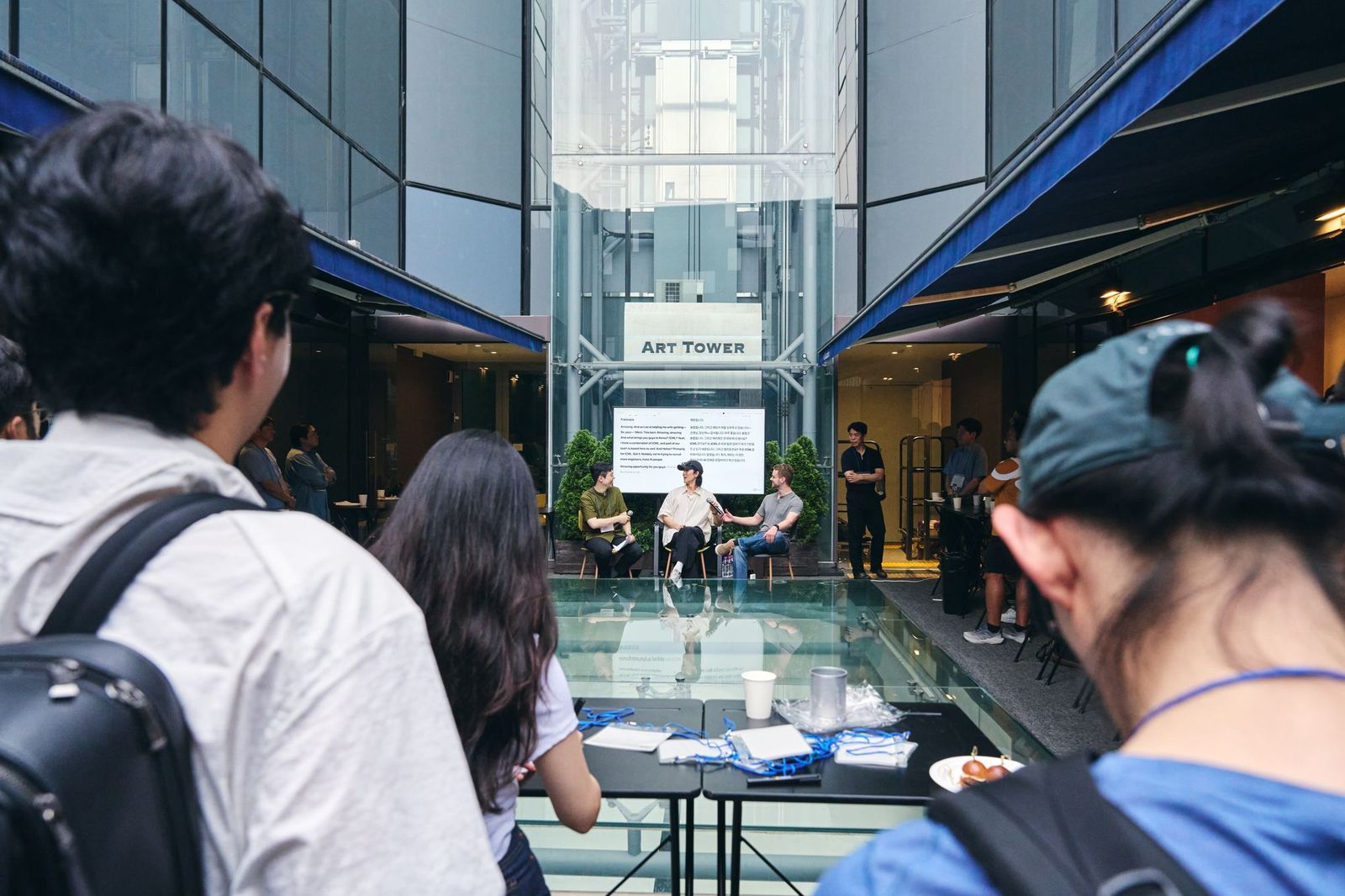
During ICML week (the International Conference on Machine Learning), we had the chance to bring in two speakers from overseas. One paves the way for founders entering the US and the UK. The other is building one of the hardest startups in the world: a personalized cancer vaccine company. For a room full of Korean builders who dream of going global, it was a perfect pairing.

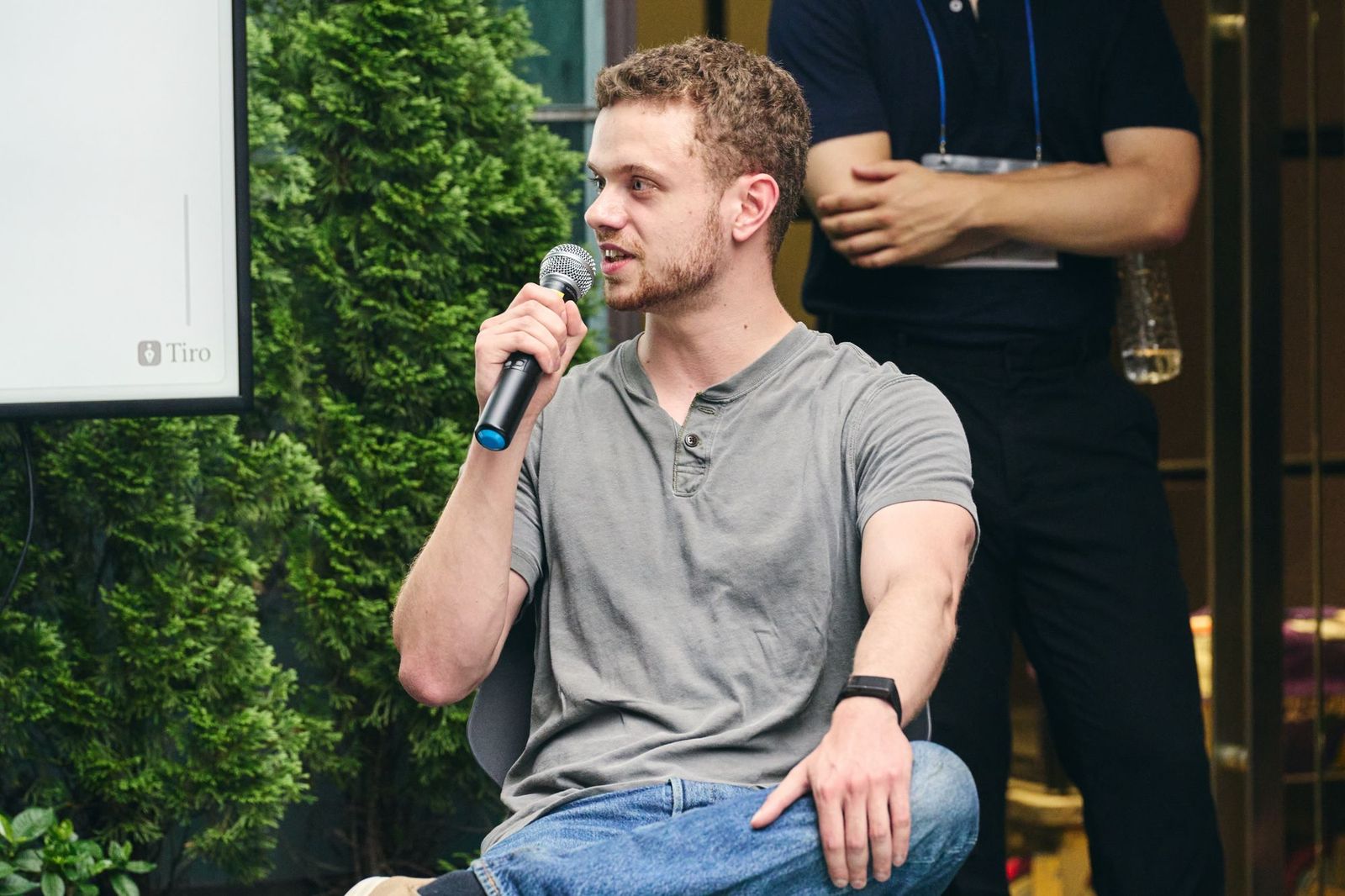
Leeho Lim is a cofounder of Expedite. He has built two YC-backed companies and is now on his third. Elian Belot worked as an AI engineer for six years before moving into biology, and became the first technical hire at Serova, a personalized cancer vaccine startup in London. One is building global legal infrastructure, the other is building cancer vaccines. Both are born global from day one.

A law firm built by someone who hates lawyers
Leeho's start was more accident than plan. He did a bachelor's in computer science at the University of Chicago and a master's at Oxford, and neither has anything to do with what he does now. He said he never set out to make founding companies his life's mission. What he was clear about is that he loves running into a hard problem and working it out. That thread runs through every business he has started.
He started his first company, Encord, with two people he met at Entrepreneur First, a startup incubator in London. All three were stuck on the same problem: data was so messy that it was hard to train machine learning models properly. They started with computer vision data. That's where luck kicked in. A gastroenterologist at the NHS, the UK's public health service, became their first customer. The results were good, so he introduced another customer, who introduced another. Back then it was just the three of them, broke data scientists getting by. Then Amazon put out a call for innovative startups to join a project with the Royal Navy. They applied figuring they had nothing to lose, and they won. With two strong references in healthcare and defense, customers grew fast.

He left the company anyway. He became CTO because he was the only one on the team who knew the tech, not because he wanted the title. Deep down he wanted to work on things beyond the tech, like fundraising and sales. He admits he rushed his second company. He felt he had to find a cofounder before anything else, so he jumped in with someone he met on YC's cofounder matching platform. They split before a year was up, before they really knew each other. Starting a company with someone you don't know well is a really bad call, he said, laughing.
He didn't rush the third one. In the meantime he made angel investments in about 40 startups and noticed a pattern. Whenever a founder who started in the UK or Canada expanded to the US, they hit the same administrative wall: immigration, corporate structure, equity for overseas employees. The deciding moment came at a lunch. A founder from his portfolio had just raised a $20 million Series A from Andreessen Horowitz and was moving to San Francisco. When Leeho heard what they had paid lawyers to flip the UK entity into a US one, he said his heart nearly stopped.

I hate lawyers. But if they're selling service this bad at this price, I figured I'd be better off teaming up with the people I hate and building something ten times better.
Expedite, an agentic law firm, started from that moment.

When software loses value, go to biology
Elian came from the opposite direction. He grew up in France and first ran into AI in high school, and he sensed it would be the technology that shaped the next few decades. He studied computer science and machine learning at McGill University in Canada, and ChatGPT came out right around when he graduated. His connection to Korea started then too. It wasn't K-pop. He hung out with Korean friends in college, came to like Korea, started learning Korean, and did an exchange semester at Seoul National University.

After graduating he moved to San Francisco, as if it were the obvious next step, and worked as an AI engineer at a software startup. About a year in, something felt off. Building products with LLMs was closer to software engineering than AI research. And as AI got better, anyone could build software, so each piece of software was actually worth less. He wanted a problem where his impact would grow as AI improved. With problems in the physical world, scientific discovery, or bio, discoveries and impact grow as AI grows. Software was the reverse.

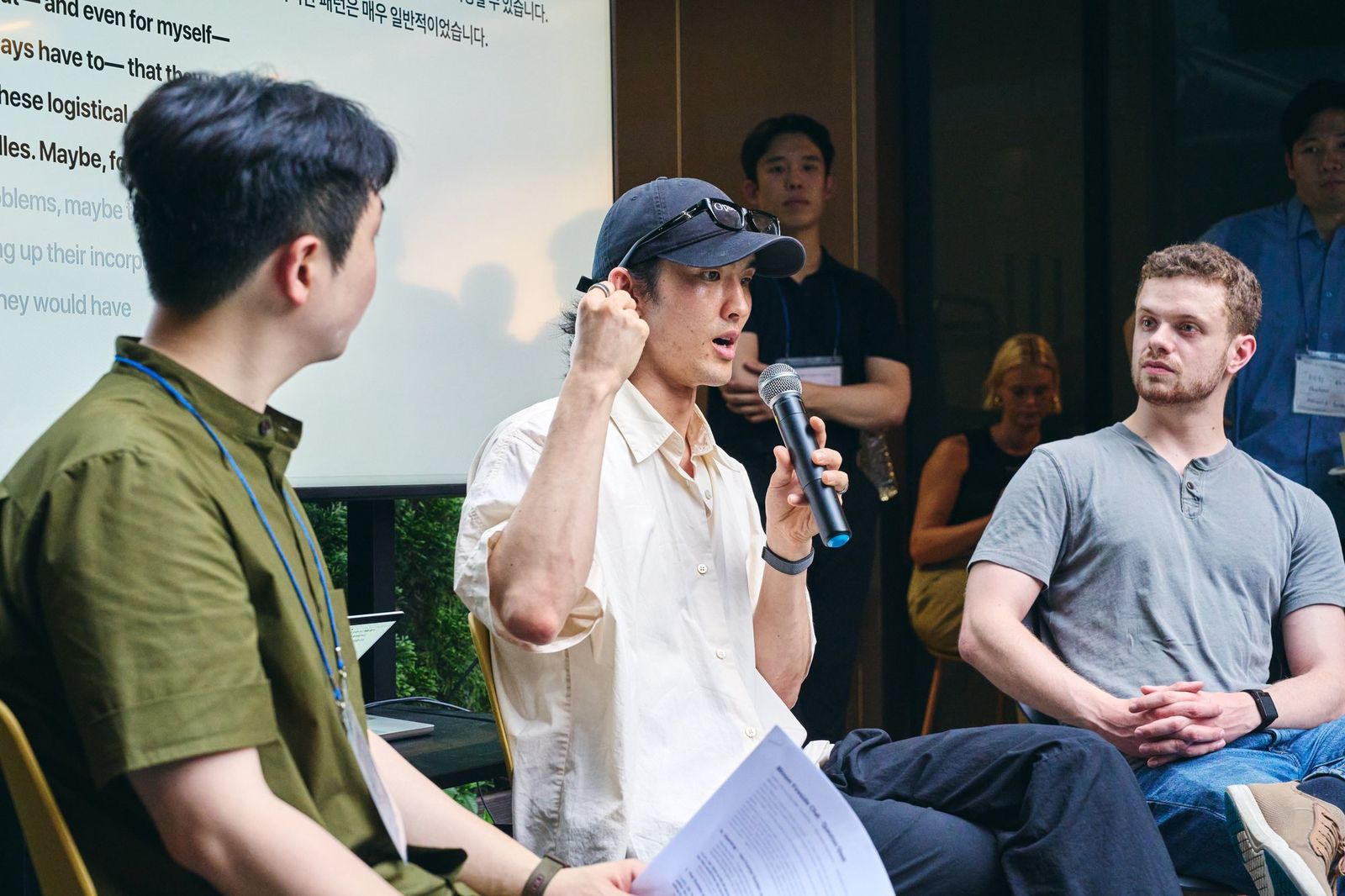
So he quit and dug into biology. What made the difference was that LLMs had made it much easier to learn an unfamiliar field. Biology deals with huge amounts of complex, unstructured data, which makes it the area where AI is most clearly useful. He spent time with scientists in gene editing, and through his network he met two founders based in Oxford who had just started a personalized cancer vaccine company. He officially joined a few months ago, moved to London, and became the first technical hire at the company, which was founded last year. The team raised $8 million in pre-seed. The fun part: Elian is now Leeho's customer. He's French, and he's about to open an office in San Francisco and move there. Expedite was helping with his O-1 visa. The two of them figured that out on stage and grinned at each other.

The US, the UK, and what makes San Francisco different
Both of them have moved around a lot, so I asked about the differences in markets and culture. Elian said he never planned to stay in France. The European mood avoids risk, leans pessimistic, and doesn't encourage you to stand out or start things on your own, so it was obvious that to found a company he'd have to go to the US. The UK sits somewhere in between. The mindset is closer to Europe, but it shares a language with the US, and whatever happens on the internet applies to the UK right away. Still, he said the overall culture isn't especially fertile for startups. It's more like there are individuals and companies scattered here and there that form strong pockets of ecosystem.
Leeho started with Paul Graham. He mentioned that Graham recently gave a talk in Stockholm on why the US, and San Francisco in particular, has such a strong startup culture, and told everyone to look it up. The core of it is community. San Francisco has a pay-it-forward spirit and a tight sense of community, so the founders you meet there hold out a hand right away and are curious about what you're working on. London, by contrast, keeps turning out unicorns, yet its community keeps getting thinner. He said even he, a British citizen, found it hard to find people to build with. Elian agreed. There are plenty of top universities and companies, but it's hard to find people you click with, and it feels like everyone is building alone in separate rooms.

Book a two-week ticket to San Francisco
So where should Korean founders go, and how? Leeho picked the US as the first market. The UK isn't bad, but selling there involves a lot of cultural nuance and unwritten rules. Much like Korea, it's tricky to get in front of the right person, build a relationship, and close. American companies are curious, have short sales cycles, and are open to startups.

He said he borrowed the method from Paul Graham, and summed it up like this. First, book a two-week flight to San Francisco. Then ask anyone you have any connection to, acquaintances or friends, for introductions. Being in a city for a short visit is itself a good reason to ask. If you're in Korea and ask someone out of the blue to introduce you to somebody, there's no clear reason for the meeting. If you're in town for a few days, it's a different story. He said every time he goes to Stockholm or Dubai, he contacts people he knows there right away and gets introduced to founders and investors worth meeting. One meeting leads to another, and the introductions snowball.

Elian added that San Francisco is surprisingly small: a population of 100,000, a hundredth of Seoul. But the density of talent and connections is high, so one connection leads to the next and eventually to the whole network. The thing he stressed most is something people rarely do in Korea: talk to strangers first. Spend a few weeks there and you'll overhear startup talk at the next table in pretty much any cafe. Just walk over and say:
I just heard what you were talking about. Here's what I'm working on. Want to connect on LinkedIn?
That one line, he said, starts a whole chain of connections. Leeho laid out the order. First, think of everyone you know in San Francisco and reach out. Next, sign up for events that catch your eye on Luma or Partiful and actually go. Finally, find the people you want to meet on LinkedIn and send something specific:

I'm coming to check out the ecosystem for a few days. Want to grab a coffee? Your background is really interesting to me because of X.
YC, visas, and practical advice
Leeho has been through YC twice, so I asked for his tips. He put it bluntly: VCs and incubators exist to grow other people's money. So you have to show signals that you'll make money. The first is traction right now. Deep tech is different, but for B2B SaaS there's no stronger signal than real revenue and a big enough market. The second is validation: showing that you've talked honestly with hundreds of customers and that this is something people really need, not a solution that went looking for a problem. He said he was rejected by YC several times himself. Even if you don't get in, good incubators keep popping up in the Bay Area, like Entrepreneur First, South Park Commons, and HF0. For people with no connections in San Francisco, communities like these are clearly worth it.
Visas came up too. He said his company has helped with more than 400 O-1 visas with a 100 percent success rate. The secret is actually being selective. The O-1 is the US talent visa, and for people they can't take on with confidence, they recommend another route first. Selling someone a visa they don't qualify for is no different from a founder giving bad advice or selling a lousy product, so they don't do it even when there's money in it. What decides an O-1 is visibility: judging hackathons, raising a bit of investment, press coverage, bylined articles, presenting at conferences like ICML. Those are the things the government looks at. He said there are other paths too, like the L-1 for transfers between companies and the E-2 for investors.

Someone asked whether targeting the US means you actually have to move there. Elian said it matters less for B2C, which is spread out by nature. But for enterprise sales, where you close big deals with a handful of customers a year over months, or for bio, where you need a lab, being face to face matters. Leeho agreed. For a product that spreads bottom-up to the general public it matters less, but for enterprise sales that go top-down, an in-person strategy is worth far more than Zoom calls. Make the first contact in person, then keep the relationship going over Zoom. He said Expedite meets VCs and incubators every month and hosts dinners and events. He came back to the power of chance. Encord's first customer came from a purely lucky encounter, he said, and nobody knows where they'll run into a customer.

What Korean founders have going for them, and cancer as an information problem
I asked Elian what strengths Korean founders have. He said every Korean founder he's met has been hungry, with a ppalli-ppalli ("hurry, hurry") streak: just go for it and move fast. At the same time they're diligent and think carefully about direction, which matters more than you'd expect. As AI gets better, the quality of your decisions gets multiplied. Americans move fast, but they don't chew on direction as much. He said Koreans are good at that slow decision of choosing what to do.
Then we moved on to cancer. Elian said cancer is a huge, universal market. The pharma industry has already gone through all the easy targets, and cancer still hasn't been beaten, because it keeps evolving and getting past the body's defenses. Where AI shines here is its ability to handle huge amounts of unstructured data. Biological data is unreadable to the human eye. The tokens ChatGPT outputs are natural language, so you can understand them. Train a transformer on DNA, though, and it outputs sequences people can't even interpret. In exchange, you can pull a huge amount of signal out of that latent space.

There's no reason cancer has to be incurable. It's fundamentally an information problem, and AI is great at handling information.
I asked what comes after cancer. He said people used to die of infectious diseases, and once we beat those, we ran into the cancer that comes with aging. Get past cancer, and aging itself will be the last problem left.

He also talked about trends. Elian said Silicon Valley is in a bit of a panic right now. YC has mostly invested in software, and ambitious people are all building similar companies. Now that AI is good enough for anyone to code, software is worth less, and without a foothold in the real world it's hard to stand out. So people are turning to the physical world.

Talk to strangers
To close, I asked for advice for Korean founders. Leeho said if your goal is to expand overseas, just go to San Francisco for two weeks, no question. If you're at the idea stage, AI is so good now that you should build a prototype of whatever it is and start. And if you're going to sell, get a very sharp picture of who your user is, then go straight at those people on LinkedIn or wherever. Elian agreed about going to San Francisco but added one caution. People there tend to converge on the same opinions. Everyone carries the same yardstick for success, builds the same companies, and gets stuck in a narrow game. So hold on to relationships outside of it, and don't feel you have to play the game everyone else is playing. Keep your identity, but learn the ecosystem.

Then came audience questions. One attendee building a product for the Middle East asked which markets besides the US have potential. Leeho said every market has its own opportunities, and it's a question of what you build for which market. He pointed to developing countries where infrastructure is lacking, fintech in the Middle East and Africa for example. But if you're doing B2B SaaS in a place like Cambodia, there may be only a few enterprise customers to sell to, so look at scale and ask whether you can grow big enough there to be a venture-scale business.
A student studying computer science in the US asked what they should do, now that software is worth less and they don't have a sharp domain like law or medicine. They wanted to know how Leeho, who didn't go to law school, closed that gap. His answer was intellectual honesty. He wasn't a lawyer, but he knew firsthand what pain people go through with legal problems, and whether he had a license didn't matter. He had lived through how badly the service ran, so he could just hire lawyers.

These days Claude spits out a contract draft really easily, a lawyer touches it up a little, and there are no gaps. Claude has cut legal work by about 90 percent. Any lawyer with a clue knows their gravy train is over.
So as a CTO, he said, you can bring anyone onto the team if you pitch them on getting much better tools. What actually matters is whether you've lived the problem and whether you can see the big picture of the solution. Elian added some good news. Contrary to what a lot of people fear, demand for software engineers is actually growing. And since you can learn anything quickly with LLMs, you don't need a PhD to get into the field you want. Show the right mindset and a few pieces of work and you're in.
We wrapped up with a big round of applause for both of them. Being born global from day one might start with something small: the nerve to talk first to a stranger in some cafe in an unfamiliar city.